

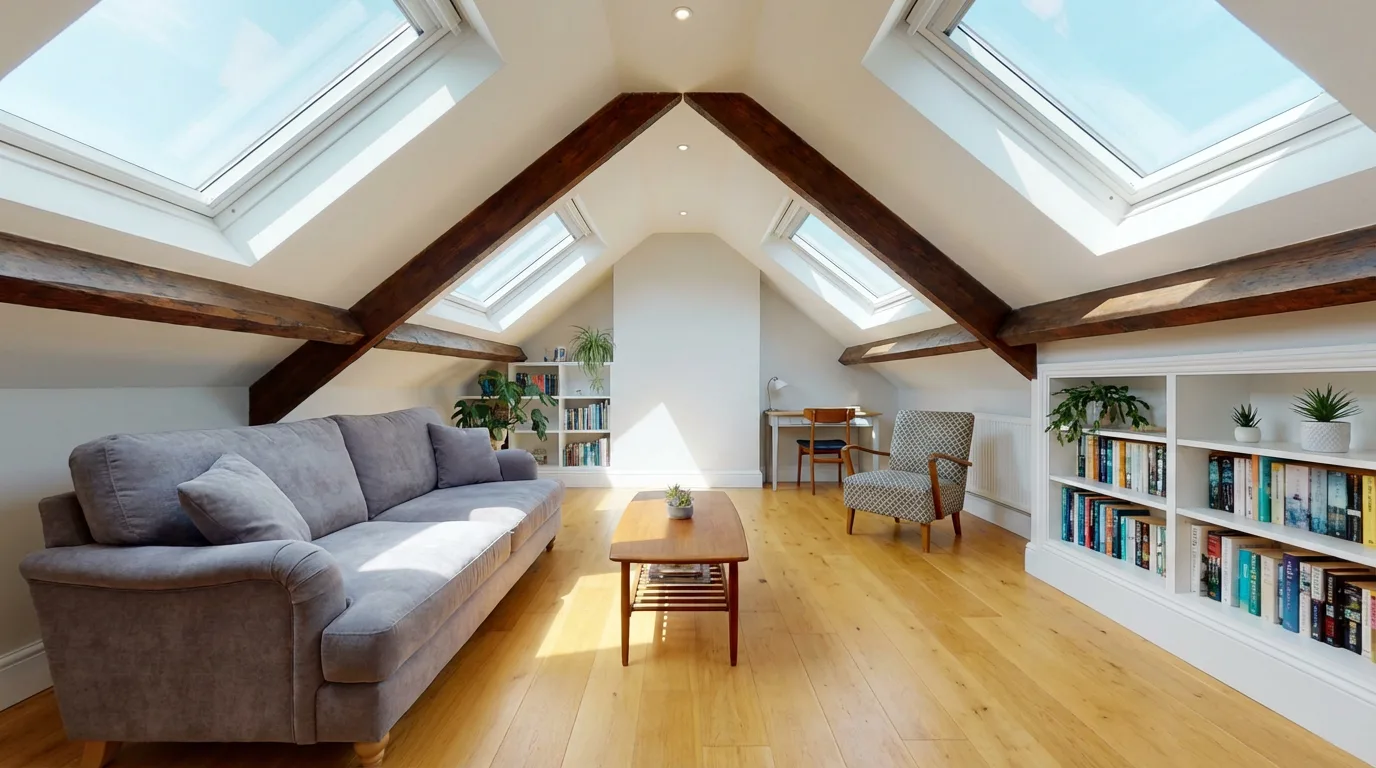
A loft conversion is one of the most effective ways to add living space without moving — particularly in cities where extending sideways or to the rear is constrained by plot boundaries or planning restrictions. Done well, a loft conversion creates a bright, private room (or two) that transforms how a home works. Done poorly, it can leave you with structural issues, planning enforcement action, or a poorly specified space that adds little value. This guide covers the four main conversion types, realistic 2026 costs, and the planning framework.
The Four Main Loft Conversion Types
1. Velux (Roof Light) Conversion
The simplest and least expensive type. Velux conversions retain the existing roofline and add only roof windows (Velux or equivalent) for light. No external alteration to the roof shape is needed. Suitable only for lofts with existing headroom (minimum 2.2m at the ridge). Typically does not require planning permission (covered by Permitted Development Rights). Cost range: £20,000–£35,000 for a basic conversion with staircase, insulation, plasterboard, and one or two Velux windows.
2. Dormer Conversion
The most common type in England. A dormer is a box-shaped extension that projects vertically from the existing sloping roof, creating a flat or low-pitch roof section with vertical walls. This dramatically increases headroom and usable floor area. Most single-storey rear dormers fall within Permitted Development Rights and do not require full planning permission (though a Lawful Development Certificate is advisable). Cost range: £35,000–£60,000 for a standard rear dormer with bedroom and en-suite bathroom; front dormers or complex configurations are higher. London costs run 20–30% above these figures due to labour costs.
3. Hip-to-Gable Conversion
Common in semi-detached and detached houses with a hipped roof (where the roof slopes on all four sides). Converting a hipped end to a vertical gable wall creates significantly more loft space. Often combined with a rear dormer. Typically permitted under PD Rights for detached and semi-detached properties (not end-of-terrace in all cases). Cost range: £40,000–£65,000 for hip-to-gable plus rear dormer combination.
4. Mansard Conversion
The most extensive and expensive type. A Mansard involves rebuilding one or both slopes of the roof at a steep angle (typically 72°) to create near-vertical walls, maximising space throughout. Usually requires full planning permission. Most commonly seen in London terraced properties. Cost range: £50,000–£80,000+, and significantly more in prime London locations where specialist contractors and high-specification finishes are the norm.
| Type | Typical Cost (England) | London Premium | Planning Permission |
|---|---|---|---|
| Velux / Roof light | £20,000–£35,000 | +20–30% | Usually not needed (PD) |
| Dormer (rear) | £35,000–£60,000 | +20–30% | Usually not needed (PD) |
| Hip-to-gable | £40,000–£65,000 | +20–30% | Usually not needed (PD) |
| Mansard | £50,000–£80,000+ | +30–50% | Full planning required |
Cost ranges are indicative estimates based on industry benchmarks for 2026. Final costs depend on property type, location, specification, and contractor. Always obtain at least three detailed quotes from RIBA-registered architects and accredited loft conversion specialists.
Planning Permission and Building Regulations
Many loft conversions fall under Permitted Development Rights and do not require full planning permission — but they always require Building Regulations approval. This is a separate, mandatory process covering structural integrity, fire safety (including fire-rated doors and escape windows), insulation standards, and staircase compliance. Budget £1,500–£3,000 for structural engineer fees and £500–£1,500 for Building Control inspections, separate from your contractor's quote.
Key Restrictions on Permitted Development Rights
Permitted Development Rights for loft conversions do NOT apply if: the property is in a Conservation Area, an Area of Outstanding Natural Beauty, or a National Park (where restrictions are tighter); the property is a flat or maisonette; previous PD allowance has already been used; or the addition exceeds 40m³ (terraced) or 50m³ (semi-detached/detached) of additional roof space. Always check with your local planning authority before proceeding.
Adding a Bathroom: What It Adds to Cost
Adding an en-suite or a full bathroom to a loft conversion typically adds £6,000–£15,000 to the project cost, depending on complexity of plumbing runs, specification of fixtures, and waterproofing requirements. A basic shower room (shower, WC, basin) at the lower end; a full bathroom with freestanding bath and underfloor heating at the upper end.
Return on Investment
According to data from UK estate agents and property valuers, a well-executed loft conversion adding a bedroom and bathroom typically increases property value by 10–20% in most UK markets — though returns vary significantly by location, property type, and market conditions. In London, where moving costs are high and space at a premium, the ROI is typically stronger. In rural markets with lower base property values, the conversion cost relative to value added may be less favourable. Always obtain a post-conversion valuation estimate from a local RICS-registered surveyor before committing to the project.
Loft Conversion Project Checklist
1. Commission a structural survey to confirm loft is suitable (headroom, structural capacity). 2. Appoint an architect for drawings — essential even for PD projects for Building Regs submission. 3. Check PD Rights apply to your property and postcode (local planning authority portal). 4. Obtain Lawful Development Certificate if proceeding under PD (protects you at resale). 5. Get 3+ quotes from specialist loft conversion companies and general builders — compare like for like. 6. Check contractor is registered with NHBC or a similar warranty scheme for structural works. 7. Ensure Building Control sign-off is obtained on completion — critical for mortgage and insurance purposes.